
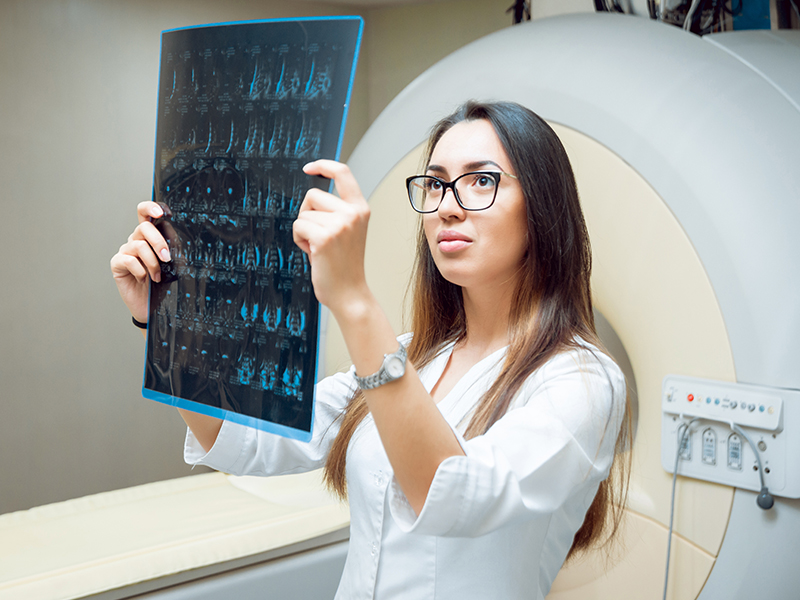
A digital X-ray is a modern form of a traditional x-ray that uses digital sensors as against traditional X-ray. Since it does away with film processing, it allows for the digital form of images in real-time, enabling many people to view them at once, in many different places. This modality enables physicians to quickly share medical images, as well as videos.
Advantages of digital X-ray compared to a conventional X-ray:
#1 Image capturing and processing
One of the key aspects of digital X-ray imaging is that after the images are captured, they are processed digitally to adjust contrast, reduce noise and improve the image quality. This allows for better visualisation of the anatomical structures and abnormalities.
#2 Immediate image availability
Unlike traditional X-rays, it may take only 5-7 minutes for a digital X-ray to complete, including creating a readable file for the doctor. In emergency situations, a radiologist can view the digital X-ray on a screen within minutes.
You can easily find a digital x-ray centre near your location by doing an online search with keywords x ray near me or x ray centre near me.
#3 Better image quality
For accurate diagnosis, it is important to have clarity and precision in images. Unlike traditional X-rays, digital X-rays offer a much higher image quality. This makes it easy for healthcare providers to focus on tiny fractures and irregularities that could have been missed on film. Since DR allows for improved definition, it becomes easier to obtain higher-quality images. In addition, DDR machines provide over 200 shades of grey, while the traditional x-rays had just between 16 to 25 shades of grey.
#4 Less radiation
The amount of radiation caused by digital X-rays is considerably lower than that of traditional X-rays, making them safer for both patients and medical professionals. Given that fewer images are needed, it means that the radiation exposure is even less.
#5 Clearer and larger images
An image captured through a digital x-ray can be immediately enlarged, allowing doctors to catch potential issues that would be too hard to see on traditional x-rays. This capability allows doctors to catch potential issues that would be too hard to see on traditional x-rays. In addition, sharper pictures allow for higher detailing than traditional radiography film, allowing doctors to see problems which might have been too small to notice. With even earlier intervention, doctors can prevent complications from ever developing, rather than having to react to problems once they’ve occurred.
#6 Images can be stored on a hard drive
Digital X-ray images can be conveniently uploaded and stored on a hard drive, making them easily accessible for viewing and analysis from any computer. The advantage of this feature is that it ensures that the images are never lost, and they can be retrieved at any time without any risk of damage or degradation.
#7 Demands less resources
DDR eliminates the necessity for chemical developers and processors. Unlike traditional X-rays, which rely on chemical
solutions for image development, digital X-rays capture and display images immediately, sparing clinics the ongoing expense and environmental impact of chemical usage. This transition eases the workflow and reduces operational costs. In addition, the absence of darkrooms or radiology suites frees up extra space.
#8 Real-time enhancement
Digital X-rays are capable of producing images instantly, allowing the doctor to adjust the exposure in real-time, making the images lighter and darker as needed to see particular aspects of the scan more clearly.
#9 Relatively easy to use
Digital X-rays are easy to use with minimal training needed to operate these machines.
To discover the best x-ray services in your vicinity, search with keywords “x ray lab near me.”
Disclaimer: For personalised advice and further information, always consult your doctor or qualified healthcare professional.
 Wellness Care Health Blog